
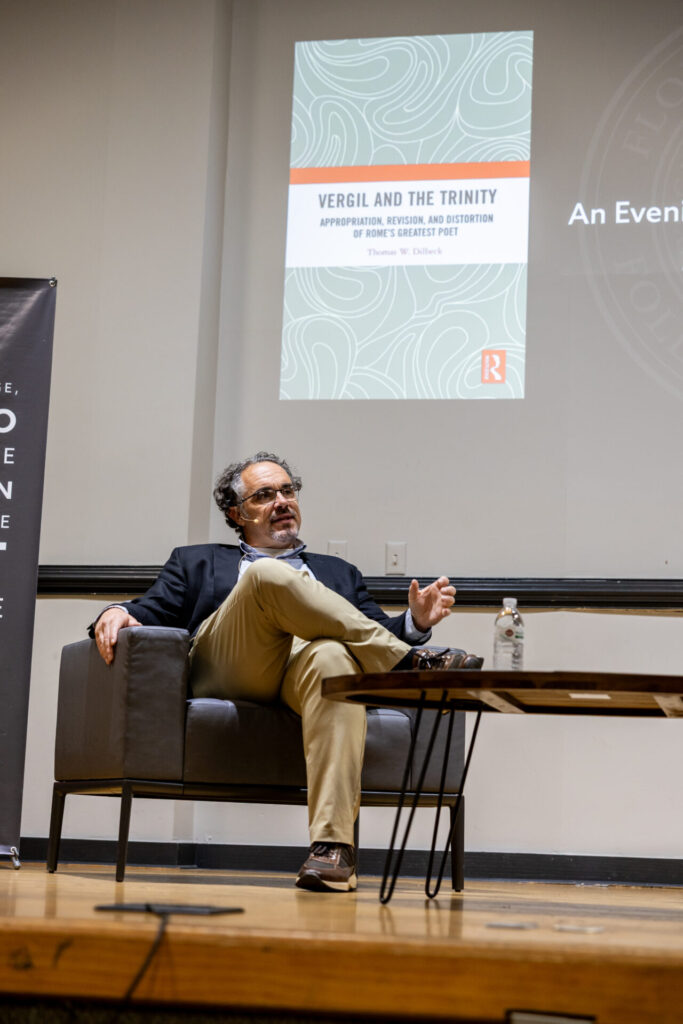
Biblical Studies Professor Brings Antiquity to Life in First Published Book
September 24, 2025 | 2-3 min read
Will Dilbeck, PhD, is drawing on lessons of the past to prepare students for the future. The Florida College Biblical studies professor recently added “author” to his list of professional accomplishments as well, extending his impact beyond the classroom. This month, Dilbeck’s first book, Vergil and the Trinity: Appropriation, Revision, and Distortion of Rome’s Greatest Poet, was released through Routledge, a global publisher of academic books and journals.
“I was a first-generation college student and didn’t even know that this world existed as a kid,” recalled Dilbeck, a native of Athens, Alabama. “Later in life I started learning Greek from a preacher and that set me on a very different path.”
After graduating from the University of North Alabama with a bachelor’s degree in marketing, Dilbeck received his master’s degree in New Testament from Heritage Christian University in Florence, Alabama. He pursued a second master’s degree (MPhil) in Hebrew and Cognate Language and a doctorate in Judaism and Christianity in the Greco-Roman World from Hebrew Union College.
Dilbeck paid a visit to Florida College while finishing his dissertation and serving as an adjunct professor in Ohio.
“I came to lectures several years ago, and that was the first time I realized how much I could help young people at this very important age,” he remembered. “The connection between professors and students here is really unique.”
Since joining FC, Dilbeck has taught multiples courses including Intro to Latin and Philosophy, Minor Prophets, Critical Intro to the New Testament, and Intro to Biblical Studies. He pursues his own academic interests as well, even visiting Italy’s Cava de’Tirreni in September to study a Latin Bible housed at a Benedictine Abbey, with hopes to publish details.
He traces inspiration for his newly released book to his doctoral dissertation, which examined Anchises’ speech in The Aeneid (Book 6) and its influence on early Christian Latin literature.
“From a practical point of view the book deals with the question of, why are Christians allowing pagan texts to influence them in such important ways?” he explained. “The larger issue is, how far can people go and resign their Christian identity? How far is too far? It’s something Christians of all ages have struggled with.”
Dilbeck hopes the book will challenge its readers, just as he strives to challenge students in the classroom.
“I want to open students up to a much bigger world of ideas than they see in our society,” he stated. “Many issues people argue about today are actually old ones, because all modern discussions have roots in antiquity. When we see how they dealt with the past it can help us know what to do. We’re not on an island trying to figure things out for the first time ever. All generations have some newer challenges, but a lot of it is rooted in the past.”

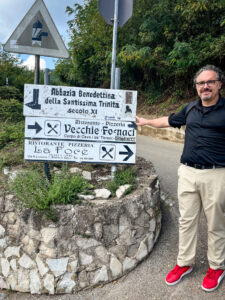
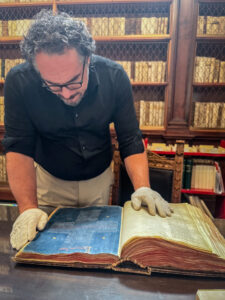
Florida College Professor Dr. Will Dilbeck recently traveled to Cava de’Tirreni, Italy, for the once-in-a-lifetime opportunity to study a rare Latin Bible manuscript housed in a Benedictine Abbey.